

 Brigadier Dr. Vijay Sagar Dheman – Retd.
The India-Pakistan Asia Cup encounter on September 14, 2025, in Dubai was a contest of two nations on the field. Yet, it was also a complex dance of diplomacy, public emotion, and global sports politics off it.The final score—India winning by seven wickets—gives only a glimpse of the bigger story. The real excitement kicked off long before the first ball was bowled and kept going long after the last one was hit.
Let us commence with the background. The controversy associated with this match originated from a tragic incident in April 2025. On April 22, a terrorist assault in Pahalgam, Jammu and Kashmir, resulted in the loss of 26 civilian lives. This heinous act was broadly attributed to terrorists supported by Pakistan. In reaction, India initiated what it termed “Operation Sindoor,” aimed at terror training camps in Pakistan and Pakistan-occupied Kashmir. Subsequently, the two nations found themselves in a heightened state of military and diplomatic tension.
This is the context in which a cricket match was scheduled. The Indian public, still understandably upset by the Pahalgam attack, strongly opposed the game. Many people, from political leaders to families of the victims, felt that playing cricket with a nation accused of sponsoring terrorism would be a betrayal of the soldiers and citizens who had lost their lives. They believed that protecting national dignity and the morale of the armed forces was more important than entertainment and revenue.
So, why did the match go on? This is where the complexities of global sports and geopolitics come into play. The Board of Control for Cricket in India (BCCI) and the Indian government were under immense pressure from international sports bodies. A top official from the BCCI explained that if India had boycotted a multi-nation tournament like the Asia Cup, the International Cricket Council (ICC) could have taken strict action, potentially even banning the Indian team. Such a move would have dire consequences for young players’ careers and India’s standing in world cricket.
India’s ambitious bid to host the 2036 Olympic Games in Ahmedabad added to this pressure. As reports have indicated, India’s Olympic dream has already faced setbacks. The International Olympic Committee (IOC) had expressed concerns over governance issues within the Indian Olympic Association (IOA) and a persistent doping problem. A boycott of a major cricket tournament would have sent a negative signal to the IOC, potentially jeopardising India’s ability to host a prestigious global event and undermining its image as a responsible and capable global power.
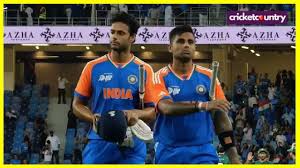
The customary handshake between the two captains, India’s Suryakumar Yadav and Pakistan’s Salman Ali Agha, was conspicuously absent at the toss. This clearly signalledthe Indian team’s firm and resolute stance. However, the real moment of controversy came at the end of the match. After Suryakumar Yadav hit the winning six, both the Indian players, instead of engaging in the traditional post-match handshake, walked directly to their dressing room. They shook hands only with their teammates and the Indian staff present, and then the dressing room door was shut. Pakistan’s players, led by their captain, were left standing awkwardly on the field. The Pakistan team’s management lodged a formal protest, calling the behaviour a violation of the spirit of sportsmanship. But the Indian team was determined to preclude any possibility of even shaking hands with the team from a rogue nation that has Indian blood on its hands.
Now let’s talk about sportsman’s spirit.Former Pakistan Prime Minister and cricket legend Imran Khan issued a statement from Islamabad on May 7, 2025, that spewed venom against India and the Indian Army. Leading the verbal offensive was former captain Shahid Afridi, who made a series of controversial remarks. On May 9, 2025, during an appearance on a Pakistani television channel, against the Indian Army, calling them “useless.”. Just days later, around May 12, Afridi and other players like Mohammad Rizwan and Shoaib Malik used social media to post a coordinated series of anti-India statements. The rhetoric escalated further on September 11, 2025. On Samaa TV, Afridi reignited a controversy by taking a dig at Indian cricketers Shikhar Dhawan and Yuvraj Singh, calling them “bechaare” (helpless). Mohammad Rizwan shared a politically charged message on social media against India. Iftikhar Ahmed made a strong anti-India remark, while Shoaib Malik’s post similarly called India names.
Perhaps most disturbing were the actions of Faheem Ashraf and Abrar Ahmed. Faheem Ashraf shared a controversial Instagram post with Ghibli-style art depicting a Pakistani soldier putting sindoor on an Indian woman, captioned “New Chapter Begins.” The post was widely condemned as a vile mockery of Indian dignity and the pain of its women—an obnoxious and inhumane act by a primitivist savage guy who has nothing but an abhorrent character. Abrar Ahmed also showed a shocking lack of sportsmanship by posting a photo of himself with a cup of tea captioned “Fantastic Tea,” an apparent reference to the 2019 Abhinandan incident, which was seen as a deliberate act of provocation.
These statements, a clear violation of the “spirit of cricket,” set the stage for the Dubai match and raised questions about whether the players could set aside their political animosity for the sake of the game. Once their true feelings and concern for Indian fans are exposed, it is natural that we should boycott the Pakistani cricketers and the Pakistani cricket team. The Pakistani Cricket Board, like their government, is already in a financial crisis. The India-Pakistan match generates nearly 350 million dollars in revenue. Why should India grant them this courtesy, which is vital for their revival? With their anti-India rhetoric, should we not cut them off for good?
During the post-match ceremony, the message from the Indian side was unequivocal. The Indian team’s response was heartrending and yet firmly against Pakistan. Indian captain Suryakumar Yadav gracefully dedicated their victory, not just to the fans or his teammates, but to the victims of the Pahalgam terror attack and to the brave Indian armed forces. He sincerely said, “We stand by the victims and families of the Pahalgam terror attack, and we express our solidarity with all of them. We want to dedicate this win to all our armed forces.” He also emphasised that the team’s actions were “our proper reply” and were entirely in sync with the government and the BCCI on this decision.
In a silent but powerful protest of their own, Pakistan’s captain, Salman Ali Agha, did not attend the post-match ceremony. Pakistan’s coach, Mike Hesson, confirmed this was a direct response to the Indian team’s firm rejection of Pakistan and its cricket team.Understanding the nuances of these events in India’s journey to become a responsible superpower soon, without compromising the security, safety, and sovereignty of India and all Indians. These events highlight India’s central challenge: balancing two seemingly contradictory positions.
On one hand, the government and the public were rightfully angry over the Pahalgam attack and the ongoing issue of cross-border terrorism. The public sentiment was that there should be no “business as usual” with Pakistan, especially not in a sport that holds such an emotional grip on the nation.On the other hand, India is striving to project itself as a responsible and mature global power. This image is crucial for its geopolitical ambitions, from its economic growth to its pursuit of hosting major international events like the Olympics. A full-scale boycott of all sporting events with Pakistan would risk international isolation in the sporting arena and could be seen as a retreat from its global commitments.
Ultimately, India chose a path that attempted to satisfy both contradictions. By allowing the match to proceed, it fulfilled its obligations to the ICC and maintained its standing in international sports. However, the actions of the Indian team—the refusal to shake hands, the captain’s statement, and the general coldness on the field—sent a clear and powerful message to Pakistan and the world. The message said: “We will play the game because we must, but we will not pretend that everything is normal. We have not forgotten and will not shake your hand in friendship.” It was a strategic move to leverage a sporting event to make a diplomatic point, without resorting to a complete boycott.This is why a cricket match in Dubai has become the subject of a global debate—it is a story of sports, politics, and the complex art of statecraft.

