

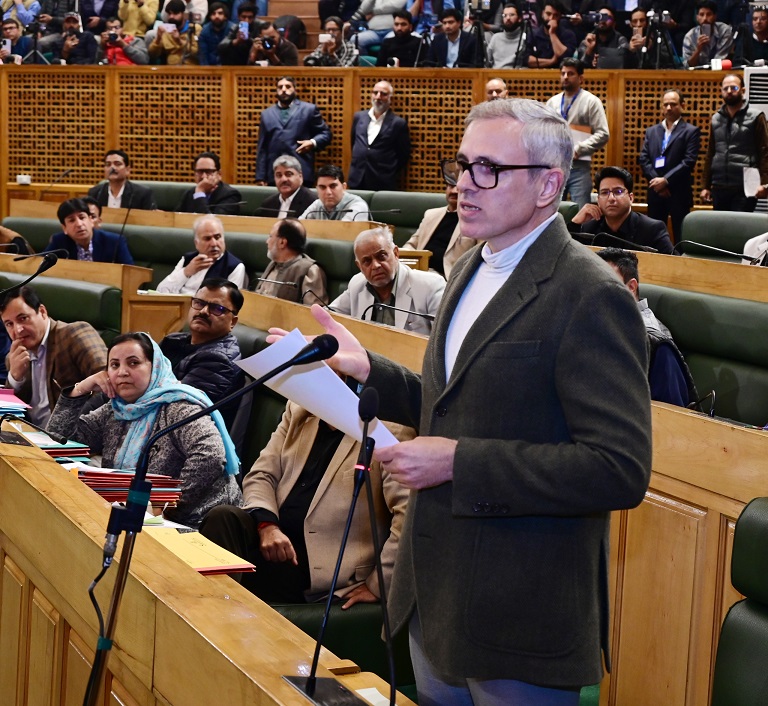
New rules give MLAs wider powers, remove spending limits, allow use of funds for calamity relief and welfare projects
PP NEWS LINE DESK
SRINAGAR Oct 29 : Jammu and Kashmir Chief Minister Omar Abdullah on Wednesday announced a series of key amendments to the Constituency Development Fund (CDF) scheme, expanding the scope of works that legislators can recommend and removing several financial ceilings that previously limited developmental activities.
Chief Minister Omar Abdullah during his address in the Assembly said the government had been reviewing the scheme for the past two months and has now approved a set of changes aimed at giving elected representatives greater flexibility to address local needs.
“We can bring some changes to this. We want to inform the House about the changes that have been approved by the government,” he said. Key Changes in Power, PHE and Health Sectors.
CM Omar informed that the ceiling under the Power Development Infrastructure category has been withdrawn. MLAs can now recommend works in this sector without any upper limit, which earlier stood at Rs. 30 lakh. Similarly, the Rs. 10 lakh ceiling for installation of solar lights has been removed.
Under the Public Health Engineering (PHE) sector, MLAs can now recommend the purchase of mobile water tankers and individual household connectivity projects. In the education sector, the purchase of school vans and buses, both three and four-wheelers, has been made permissible.
In the health sector, the purchase of wheelchairs, tricycles, and both manual and motorized electric scooters will now be allowed under the revised guidelines.
Special Provisions for Calamity Relief: Referring to the devastating floods that recently hit parts of the region, CM Omar said a one-time relaxation for MLAs to utilize up to Rs. 50 lakh from their CDF allocation for the rehabilitation of calamity-affected families. The relaxation will apply to the current financial year and 2026–27.
Additionally, MLAs from non-affected areas will be able to recommend works worth up to Rs. 10 lakh in disaster-hit constituencies or contribute to the Chief Minister’s Relief Fund, with specific directions for use in the affected areas.
Removal of Spending Restriction and Introduction of New Categories: The Chief Minister said the provision requiring MLAs to spend 80% of their CDF allocation within a financial year has been scrapped. “We have removed this provision. Now, we have not kept this 80% requirement for MLAs,” he said.
He noted that while the CDF framework will continue to draw from the Member of Parliament Local Area Development Scheme (MPLADS), certain improvements have been introduced. Temporary sheds for people affected by natural calamities like earthquakes, floods, and droughts will now be allowed under the CDF.
Grants of up to Rs. 3 lakh will be permitted for old age homes, shelters, and orphanages for purchasing bedding, utensils, books, and uniforms. Youth clubs and sports organizations can now receive similar grants for buying sports equipment through government channels.
Housing Support for Marginalized Groups: The Chief Minister also announced that up to Rs. 20 lakh from the CDF can be directed to assist the economically weaker sections, including drivers and Below Poverty Line (BPL) families, for upgrading their housing units. The funds will follow the model of the Pradhan Mantri Awas Yojana (PMAY) and will be subject to verification and scrutiny.
“These reforms are meant to make the CDF more responsive to the needs of the people and to empower MLAs to deliver targeted support where it is most required,” Omar told the House.
The revised CDF guidelines are expected to take effect immediately after formal notification by the government.
Recognizing the hardship faced by families affected by natural calamities, the Chief Minister announced a one-time relaxation permitting utilization of up to ₹50 lakh from CDF for the construction and repair of houses for calamity-affected families during the current and next financial year (2025–26 and 2026–27).
In another major reform, the earlier clause requiring MLAs to utilize at least 80% of funds in a financial year—failing which next year’s release was withheld—has been deleted to enhance operational flexibility.
The Chief Minister said the revised guidelines will align the CDF Scheme more closely with the MPLAD funds model while retaining certain permissible activities unique to the CDF that cater to local exigencies and social welfare.
He said that activities such as construction of temporary shelter sheds for people affected by natural calamities like earthquakes, floods, and droughts will continue to be permissible under the CDF. Similarly, financial assistance to old age homes, orphanages, and shelters for purchasing essential items like bedding, utensils, books, and uniforms subject to a ceiling of 3 lakh will also remain part of the scheme.
The Chief Minister added that youth clubs and sports organizations will be eligible for grants up to 3 lakh for purchasing sports equipment through government-recognized agencies.
He further said that MLAs from non-affected areas can recommend works or contribute funds up to ₹10 lakh in areas hit by natural calamities such as floods, cyclones, earthquakes, or droughts, either through the concerned Deputy Commissioners or to the Chief Minister’s Relief Fund with specific stipulations for use in the affected regions.
The revised guidelines will also allow channeling up to ₹20 lakh under the CDF for the upgradation of houses belonging to tribal and BPL families. This assistance will be provided on a rolling basis, aligned with the provisions of PMAY, and governed by stringent verification and scrutiny norms to ensure transparency and accountability.
“These changes are intended to make the CDF scheme more inclusive, responsive and development-oriented, ensuring that our MLAs are empowered to directly address the needs of their people,” Omar Abdullah added.
However, Chief Minister Omar Abdullah on Wednesday said that the National Law University (NLU) in Jammu and Kashmir is expected to start functioning from April next year from rented accommodation and that Ompura in Budgam could be the primary location for the varsity.
Speaking in the Assembly over the resolution brought by MLA Bandipora, Nizamuddin Bhat, CM Omar said that the government has plans to come up with the National Law University (NLU) as the grant of Rs 50 crore has already been kept for it.
As the resolution was passed in the House, the Chief Minister stated that they expect that the classes at the university would start from April next year.
“Although there has been no decision on the location yet, I have asked my colleagues to identify an apt location for it. However, at present, we have a space available in Ompura, Budgam, which is lying vacant. We have an option to come up with the varsity there as well,” he said.
Bhat brought the resolution to the House, seeking construction of the NLU in Bandipora constituency. MLA Sonwari, Hilal Akbar Lone, however, brought amendment in this regard, seeking the university to come up in his constituency.

